Andualem Belachew Workie, Ph.D.

Predictive Materials Engineering

A.B. Workie, Ph.D.


Materials Scientist · Predictive kinetics of bioactive Materials


I study when bioactive ceramics release their ions, not only what they release. Bone repair unfolds in stages over days to weeks, yet ceramics are usually designed by composition and judged at a single endpoint. My work shows that thermal processing can reprogram silicate network connectivity (Qⁿ) and change dissolution at fixed composition. I am now building models that predict the time course of Ca, Si, and Mg release from processing and scaffold architecture. 
[Picture]
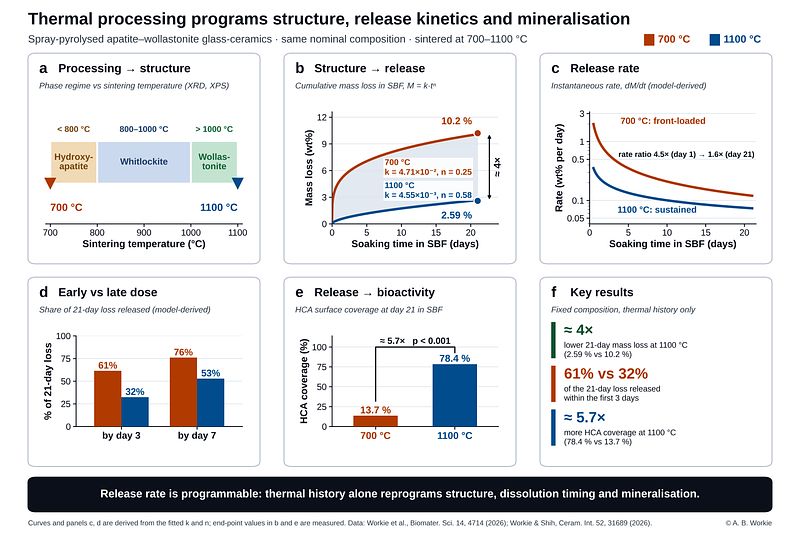
Thermal history alone reprograms phase, dissolution and mineralisation in apatite–wollastonite glass-ceramics: at fixed composition, 21-day mass loss differs about four-fold (10.2% vs 2.59%) and HCA coverage about 5.7-fold (13.7% vs 78.4%).

 About 

I am a materials scientist who moved from teaching mathematics and physics into bioceramics research. Years of explaining mechanics and thermodynamics from first principles shaped my approach: identify the simplest physical quantity that explains a result, then test it experimentally.

My doctoral work at National Taiwan University of Science and Technology (2020–2023) established the experimental foundation: spray-pyrolysis synthesis of apatite–wollastonite glass-ceramics, with bioactivity and cytocompatibility assessed under ISO 23317 and ISO 10993-5. Since 2023 I have led an independent line of research on predictive release kinetics, using kinetic analysis and reaction–diffusion modelling to forecast ion release from processing variables rather than only measuring it after the fact.

 Skills 

Synthesis: spray pyrolysis, melt-quench and sinter-crystallisation of glass-ceramics.
Characterisation: XRD with Rietveld refinement, XPS (O 1s NBO/BO analysis), SEM, BET, ICP-OES, in vitro bioactivity (SBF) and cytocompatibility assays; interpretation of ²⁹Si MAS-NMR.
Modelling: dissolution kinetics, moving-boundary reaction–diffusion models, Bayesian calibration, Python. 

Professional Memberships

  • Tissue Engineering & Regenerative Medicine International Society (TERMIS) 
  • The Institute of Materials, Minerals & Mining (IMO3), Associate of the Institute of Materials, Minerals & Mining

Research

Bioactive ceramics can instruct bone cells through the ions they release, but healing is a sequence: inflammation clears in the first days, macrophages shift toward repair over the first week, and mineralisation continues for weeks. My research asks whether the timing of ion release can be designed and predicted, in the same way that composition has been.
Theme A: Programming dissolution through processing
Question: Can thermal history change release at fixed composition?
Approach: Sinter-crystallise spray-pyrolysed apatite–wollastonite powders across 700–1100 °C, track phase evolution, Qⁿ connectivity and dissolution in SBF.
Result: Dissolution parameters changed markedly with temperature (n = 0.25 at 700 °C vs n = 0.58 at 1100 °C), and 21-day mass loss differed about four-fold (10.2% vs 2.59%). Surfaces templated about five-fold more bone-like mineral (78.4% vs 13.7% coverage).
Papers: Ceramics International 2025; (Kinetic Blueprint); RSC Advances 2026; (crystallisation pathways); Biomaterials Science 2026.(Predictive mass-transport kinetics)
Theme B: Predictive transport and moving-boundary models
Question: How do chemistry and architecture jointly set release over time?
Approach: A moving-boundary reaction–diffusion framework with Damköhler–Péclet regime maps, linking dissolution, pore evolution and transport.
Status: Preprint under review at the Journal of Functional Biomaterials.(Preprint) 
Theme C: Open computational platform
Question: Can kinetic models be calibrated and shared reproducibly?
Approach: KineticAI-AWGC provides open solvers, Bayesian calibration workflows and datasets with a DOI-registered archive.
Outcome: Others can reproduce, test and extend the models.
Theme D: Where this is heading
Question: Does the rate at which ions arrive matter for cell fate, independent of total dose?
Direction: I am developing experiments in which release rate is varied while composition and cumulative dose are held fixed, together with models that predict release before scaffolds are made.
I label each result as measured, published, implemented in code or planned, so readers can see what the evidence supports.

Publications

Predictive kinetics (since 2023)
  1. † Workie*, Taye, Melchels, Mamo. Predictive mass-transport kinetics in phase-programmed silicate glass-ceramics for controlled microenvironmental engineering. Biomaterials Science, 14, 4714–4723, 2026. doi:10.1039/D6BM00997B
  2. † Workie*. From static material design to predictive open-loop control via chemistry–architecture coupling in a moving-boundary reaction–diffusion framework. ChemRxiv, 2026 (under review). doi:10.26434/chemrxiv.15008964/v1
  3. Workie*, Shih. A kinetic blueprint for bioactive ceramics: programming the bio-interface through thermal processing. Ceramics International, 52, 31689–31695. doi:10.1016/j.ceramint.2025.11.19
  4. † Workie*, Taye. Sequential crystallization pathways in apatite–wollastonite glass-ceramics via spray pyrolysis. RSC Advances, 16(17), 15242–15248, 2026. doi:10.1039/D5RA08885B
Software and data   
  • † Workie. KineticAI-AWGC: spatiotemporal modeling of bioactive silicate ceramics. Zenodo, 2026. doi:10.5281/zenodo.21759552
Innovation
  • † Workie (sole inventor). Binary Mechanochemical Memory Surface (BCMS) for solid-state cellular force recording. TIPO Patent Application 115134815, filed 28 August 2026.

Collaboration and Contact

Open to collaboration on
  • Release-kinetics modelling for your ceramic, glass or composite system
  • Structure–dissolution studies (XRD, XPS, NMR interpretation)
  • Testing or extending the open platform on new datasets
  • Cell-based studies in which release rate can be controlled independently of composition

 Education

Ph.D., Materials Science and Engineering, NTUST, Taiwan, 2023
 M.Sc., Materials Science and Engineering, Bahir Dar University, 2018
 B.Sc., Physics, Debre Markos University, 2014